
When the thought of dragging a heavy suitcase to your accommodation feels daunting: We will provide a complete guide on how to use Hakata Port taxis, the most comfortable mode of transportation
NEW CAMELLIA FERRYStepping foot in Hakata Port after crossing the Korea Strait overnight on a Hakata Port taxi. While there is a strong perception that Japanese taxis are expensive, they can actually be a reasonable choice if you are traveling with a large group or want to plan your itinerary efficiently. Today, we provide detailed information on the latest fare system for 2026 and boarding locations.
🚕 Key Summary of Using Taxi at Hakata Port ✔️
✅ Maximum Convenience: If you have a lot of heavy luggage or are traveling with children or parents, a taxi is the most reasonable choice, as you can board directly at the platform in front of the terminal's main entrance without waiting for a bus.
✅ Smart Payment: As of 2026, Japanese taxis support not only cash but also various payment methods such as credit cards, Travelog, Kakao Pay (linked with Alipay), and Apple Pay, making them very convenient to use.
✅ Accurate destination delivery: If you are worried about communicating in Japanese, you can show the address in Japanese on Google Maps or note down the phone number of the hotel you wish to visit in advance, and you can arrive without error through navigation search.
1. Taxi Stand Location and Precautions for Use
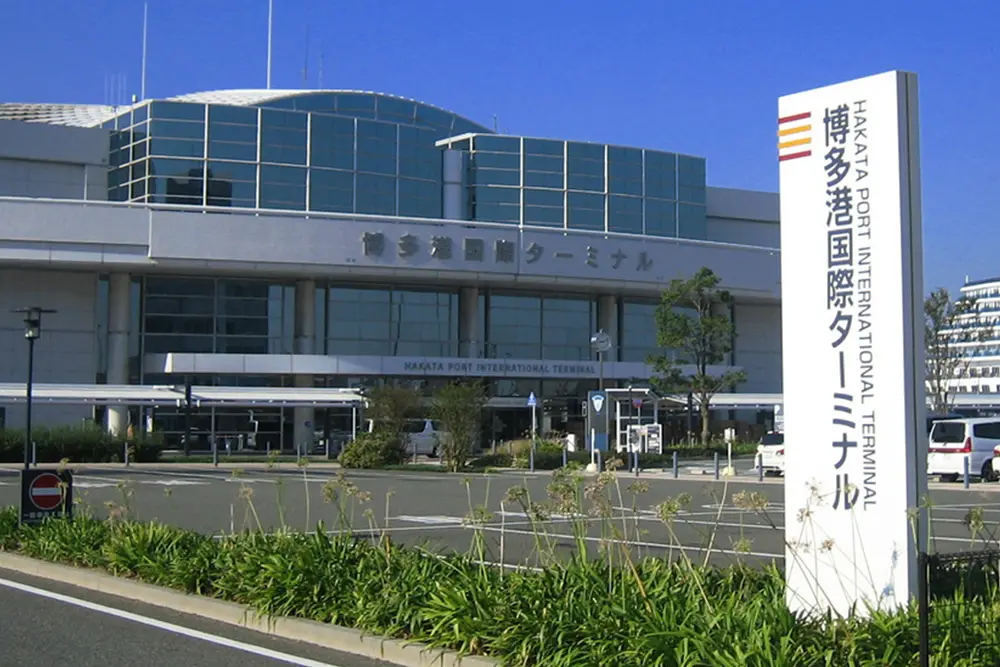
The structure of the Hakata Port International Passenger Terminal is very simple, so there is almost no need to worry about getting lost. Once you have completed immigration and customs inspections and exit through the main entrance on the first floor, you will find a bus stop immediately to your left and a long taxi stand at the far right. Since the terminal building and the bus stop are not large, they are very easy to find.
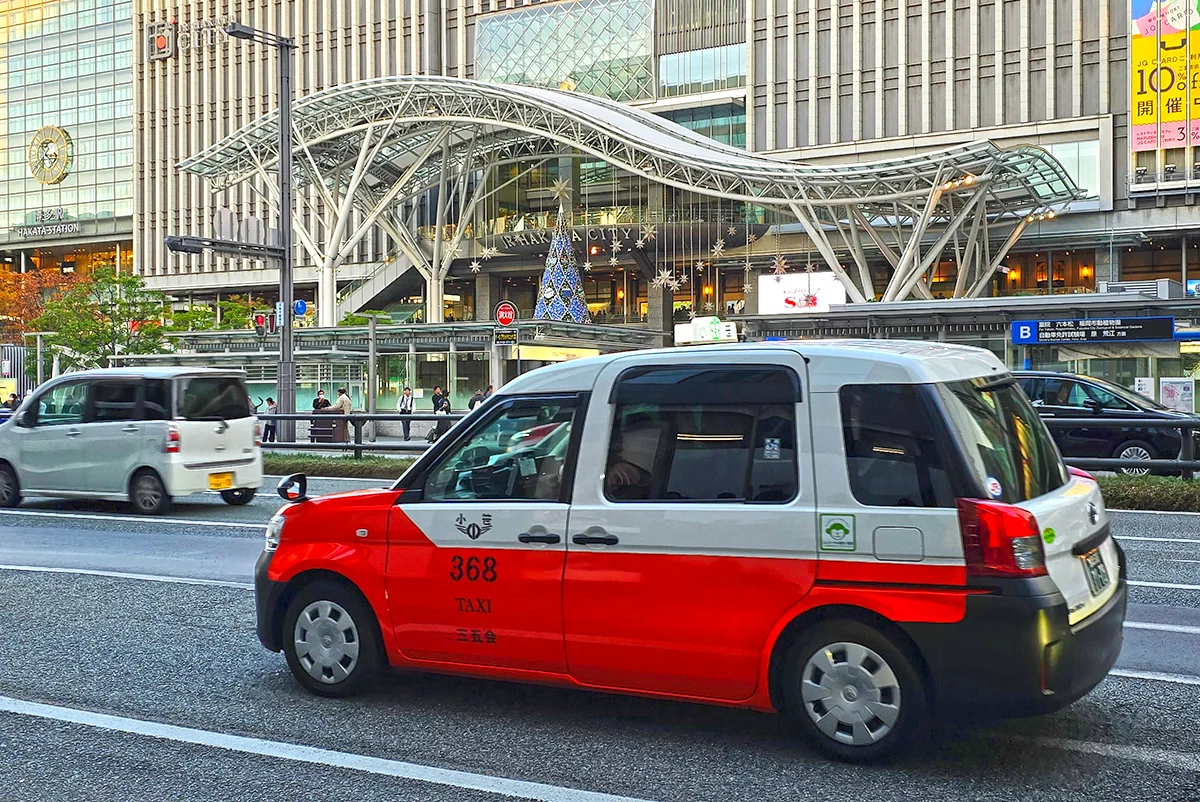
The first thing to remember when using a taxi in Japan is the "automatic doors." Unlike in Korea, passengers do not need to open or close the doors themselves; please stand a step back and wait until the driver automatically opens the rear door. This is because holding the door yourself can put strain on the mechanical mechanism. If you have a lot of luggage, the driver will get out and load it into the trunk for you, so it is better to accept their assistance rather than trying to load it yourself. As of 2026, not only standard sedan taxis but also 5-6 seater large taxis (Jumbo Taxis) are often available at Hakata Port, so if you have a large group, you can inquire with an attendant or a driver to be assigned a suitable vehicle. In particular, taxi queues at Hakata Port can get long when cruise or ferry passengers disembark all at once, but the dispatch system is very fast, so your turn comes quickly.
2. Analysis of Estimated Fares and Travel Times by Major Locations
Let's take a detailed look at the estimated taxi fares from Hakata Port to the most popular tourist areas: Hakata Station, Tenjin, and Nakasu. Since Japanese taxi fares are calculated based on a combination of distance and time added to the base fare, there may be slight variations depending on traffic conditions.
- Hakata Station: Takes approximately 15 to 20 minutes . As the transportation hub of Fukuoka, the fare to Hakata Station varies depending on traffic conditions, but you can expect to pay roughly 1,800 to 2,200 yen . For a family of four traveling with luggage, the cost is about 500 yen per person, making it a well-deserved choice even when compared to the bus fare (240 yen). Since traffic congestion is frequent on the route from Hakata Port to Hakata Station during rush hour, an additional 5 to 10 minutes may be added during heavy traffic.
- Tenjin Station and Iwataya Department Store (Tenjin Area): Tenjin, the mecca of shopping, is very close to Hakata Port. It takes about 10 to 12 minutes to arrive, and the fare is approximately 1,300 to 1,600 yen. This is the most recommended mode of transportation for those staying at a hotel in the Tenjin area.
- Nakasu Street Food Stalls: approximately 8 to 10 minutes . You can travel to Nakasu, the hub of Fukuoka's nightlife, for about 1,200 to 1,400 yen. This is useful if you plan to drop off your luggage and head straight for a meal on the day of your arrival.
- ❤️ To get to the taxi stand, make sure you enter Japan safely first~ Preview of Japan immigration procedures & VisitJapanWeb registration 👇
3. Payment Methods and Smart Usage Tips
Over the past few years, payment systems in Japanese taxis have advanced dramatically. While cash payments were once mandatory, as of 2026, taxis at Hakata Port support not only credit cards but also foreign currency cards like Travelog and Travel Wallet, as well as Kakao Pay (linked with Alipay) and Apple Pay. However, in rare cases, very old vehicles may lack a card terminal or have one that is broken, so it is convenient to check for the payment-enabled logo attached to the exterior of the vehicle. "Before boarding, it is a good idea to check for the card/QR payment sticker on the window or double-check by asking, 'Card daijoubu desu ka? (Is a card okay?)'"
When telling the driver your destination after getting into a taxi at Hakata Port, it is recommended to show them the Japanese address on Google Maps. In particular, since Japanese taxi navigation systems are very accurate with phone number searches, writing down or capturing the hotel's phone number in advance will make communication much faster.
4. Editor's Recommendation
The first impression of a trip is determined by the comfort you experience immediately upon arrival. Instead of waiting for a bus and struggling with your luggage inside a cramped vehicle, a Hakata Port Taxito leisurely enjoy the streetscapes of Fukuoka through the window. A tip we always share with our TRAVELWINGis to "invest the money you saved on airfare into local convenience." TRAVELWING's NEW CAMELLIA FERRY , we hope you will conserve your energy by traveling comfortably by taxi on your first day of arrival.

- 👇Click here for further questions regarding reservations or boarding! 👇
- 👇Check NEW CAMELLIA FERRY check-in and boarding guide after purchasing the Fukuoka BOARDING PASS
- 👇Level up your cafe membership and become a KakaoTalk friend to receive a flood of extra discount coupons! 👇